Monday, March 07, 2011

Campaign Progress - and Fund Raising Dinner


The campaign to save our accident & emergency unit continues. This afternoon a delegation from Redbridge visited the Independent Reconfiguration Panel (IRP) HQ in Buckingham Palace Road. The rather complex title belies the fact that these are the people who will give the thumbs up or down to the closure plans.


Arriving early, I took the opportunity to speak to the board secretary about our campaign and he assured me that the board would consider all submissions fairly.


I was joined by Redbridge councillors Andy Walker (Labour, and the driving force behind our objections) and Chris Cummins (Conservative chairman of the health scrutiny committee), and we handed in a letter drawing attention to the overloading of the services at Queen's Hospital and pointing out that they were in no condition to carry the extra demand which would be created by the KGH closure.


The next step will be a fund raising dinner on Friday evening in Chadwell Heath.


UPDATE: The dinner at the Tamarind in Chadwell Heath was a great success, raising several hundred £s for the campaign. Thanks to Cllr Andy Walker for organising the event. I'm adding a picture of the evening...

Friday, March 04, 2011

Alternative Funding


With funding cuts and government struggling to recover from Labour's financial mismanagement, the hunt is on for alternative methods of funding capital projects. The budget committee spent a couple of hours taking evidence from experts in TfL and the GLA yesterday morning.

Crossrail, Tube upgrades and Thameslink are all able to go ahead but other projects, notably the extension of the Northern Line to Battersea will need to be funded by innovative methods. Because transport projects usually generate an increase in property values along the route, some form of land value taxation could be considered. This was always a favourite with former TfL deputy chair Dave Wetzel, but unfortunately he was not around to offer his opinion.

Battersea Power Station has been an ill starred development site for a long time, with various proposals coming and going whilst the giant building - closed thirty years ago - falls into dereliction. The latest plans look like coming to fruition and as it is now just about the last bit of undeveloped river bank, they look to generate considerable profits. However as always there was a risk that land values would fail to rise and the revenue would not be created, or that the balance between residential and commercial uses would fail to maximise income, or that the amount raised would still cover only a fraction of the cost of the line extension - the experts differed on this, predicting that anything from a tenth to two thirds of the cost could be raised.

Of course some of us remember Ken's predictions that rising land values in the Lea Valley would pay for the Olympics, and that the house he bought for Bob Kiley would be sold at a profit...


Crossrail

Discussion turned to the community infrastructure levy (CIL) which will generate some £300 million for the Crossrail project. In effect this will be a 'planning gain' charge attached to developments within Greater London. Local authorities already raise money in this way, but its use is restricted to major developments. The CIL will apply to all non domestic planning applications.

The plan has raised major concerns amongst London's councils and Bromley have agreed to mount a legal challenge - not for the first time, for those who remember 'Fares Fair'.

The first problem is that the CIL will only apply within Greater London. The extra cost of development will tend to push businesses over the border into the Home Counties, particularly from outer London boroughs. There is also a reasonable argument that Crossrail is a project with national benefits, so the whole country should pay. A stretch to ask Scotland and Wales to cough up perhaps, but Crossrail will actually stop at Brentwood and Maidenhead, so it is only fair that they make some contribution. It feels like the London only Olympic levy all over gain.

Then there are concerns about the distribution of the charge within London. The legislation that enables the CIL does not allow the charge to be focused along the route where the benefits will be felt. The only variation that is allowed across London is based on existing property values and there are three charging bands. Luckily Havering is in the cheapest band and Redbridge is in the middle band - both get the benefits of access to the route and new stations, so far so good. However Richmond is in the top band and the line goes nowhere near them - needless to say they are not happy, and other north and south London boroughs share their concerns.

CIL only applies to Crossrail at present, but the witnesses accepted that it could be used to raise money for other transport projects, including a resurrected Cross River Tram. The legislation seems blunt and doesn't consider London's size and variation - not for the first time - so the witnesses did agree that the government should be pressed to make changes next time the matter came up for debate.

Monday, February 28, 2011

London Conference


Saturday saw the London Conservative conference, kindly hosted at Hammersmith Town Hall. Left wing bloggers billed it as a 'secret gathering' and promised a large demonstration - but as it started early on a Saturday morning and it was pouring with rain very few people turned up to man the picket lines - I guess the revolution will have to wait.


Inside a packed hall, we were addressed by Boris who outlined his achievements and his plans to seek a second term. He takes his opponent seriously, describing Ken as a 'seasoned campaigner - more than seasoned, marinated perhaps or even embalmed.' He took some good natured questions and our own Cllr Nick Hayes made the best of the opportunity to seek assurances that the overground improvements which form part of Crossrail would still take place. Boris pointed out that Network Rail were responsible for the stations in Redbridge and Havering, and that he would lobby them to ensure the essential improvements were made.


Lynton Crosby spoke to us about the campaign, revealing all the secret details which I won't repeat here. Then we had sessions on the No To AV campaign and the upcoming boundary review which will see London lose several Parliamentary seats.


Then we were addressed by Transport Secretary Philip Hammond, who talked about his support for Crossrail and his commitment to transport in London. Governments always face pressure from Scottish and Northern MPs to cut London's funding so it is reassuring to have the Minister on our side. He acknowledged that he faces a fight over high speed rail but is determined to press ahead with it as the only viable alternative to airport expansion in the south east.


We broke for lunch with our MEPs, providing them with an opportunity to talk about their work and face the tough grilling that this subject always attracts at party meetings.


Then it was on with the afternoon, and a session on local government chaired by Wandsworth Leader Edward Lister and featuring a star panel - including myself. I spoke about how proportional voting had twisted London Assembly politics, giving Lib Dems and Greens far more power than they merited, and talked about the sometimes tense relationship between my team and the Mayor's office. We also had a good discussion about cutting waste, sharing services and improving procurement to get a better deal for taxpayers.


With that session completed it was time to slip away. I had to miss the final session with London's new MPs because I was off to the Havering Mayor's fund raising evening. A very exciting boxing match and dinner hosted at the Prince Regent Hotel in Chigwell. There was just time for me to get home and change for the event.


A productive Saturday with plenty of jabs and crosses hitting the target!


Thursday, February 24, 2011

Big Budget Day


Wednesday saw the agreement of 2011/12 budgets both at City Hall and Havering Council.


Greater London Authority


Boris presented his final budget to a full meeting of the assembly. He had noted our concerns about plans to spend £6 million on the 101 single telephone number for public services in London. He assured us that he would be reviewing the project. Having received this assurance, the Conservative Group withdrew that part of its amendment.


Political groups presented amendments that remained largely unchanged from two weeks earlier, with the exception of the Greens who wanted to spend £4 million on the Year of Walking. None of the amendments attracted enough votes to clear the necessary two thirds hurdle required for their adoption.


John Biggs lost his temper with the mayor, calling him a 'lazy liar' and a lot more before the chair proposed a vote to exclude him from debate - which was passed. Biggs is often casually rude but it seems to arise from thoughtlessness and I don't take offence. There is however something about Boris that gets under his skin and sometimes he really loses it. This was one of those occasions and it was the first time in its history that the assembly voted to silence one of its own members - not a very welcome precedent, particularly as the session was going out live on BBC Parliament.


With no amendments, the mayor's budget was approved by default, giving Londoners another year's council tax freeze, the third in a row - contrasting with Livingstone's 154% increase over his term of office.


London Borough of Havering


With riots and the police called to some council meetings, we were on the edge of our seats in the evening. However there were no protests and the meeting was very civilised.


Over the years Havering has become accustomed to being short changed by central government, so the council is used to introducing efficiencies and sharing services to save costs. The difficult budget was masterfully constructed by Cllr Roger Ramsey and his team of finance officers, working with the unions who therefore did not find it necessary to wave placards outside the meeting.


The Labour opposition didn't propose any alterations to the budget, although a couple of them did dedicate their speeches to polishing Gordon Brown's reputation, after young Conservative councillors made references to the dreadful economic legacy he had left.


The Official Residents' Association councillors proposed introducing free parking in their wards and paying for it by cutting special responsibility allowances and consultancy fees. This is pretty much what they do every year.


The Independent Resident's Association Group (yes, it really is like Monty Python's Life Of Brian) proposed spending £5,000 on a legal challenge to force more grant from the government, but this was disallowed by the Mayor because they had failed to identify where the money was coming from and £5k won't get you a cup of tea at the High Court these days.


With little else on the table the opposition groups congregated around the free parking amendment which fell to the overwhelming Tory majority. However there was some consolation for them in the Leader's announcement that several committees would be scrapped along with the chair's allowances (my own Partnerships Scrutiny Committee included). The Deputy Mayor would also have his allowance ceased, although he would still fulfil his duties.


The administration budget was approved, freezing the council tax at £1,505 for a Band D property.

Sunday, February 20, 2011

Save The Accident & Emergency

Following last week's council resolution, there was a meeting of representatives from Havering and Redbridge on Friday, to plan the way forward.

New figures obtained from the plans show that outer London is set to lose out again. With A & E focused on Queen's Hospital for three London boroughs, that overstretched unit will have to serve a population of over 700,000. This compares unfavourable with the North East Inner London hospitals each serving a single borough of just 200,000 people. No doubt the statistics claiming that Inner London has greater 'needs', poverty etc. will be trotted out again but account never seems to be taken of Havering's large elderly population. Older people need more hospital services.

And whilst Waltham Forest Council have decided no to oppose the changes, we noted that there had been no assessment of the additional pressure that will be placed on A & E at Whips Cross Hospital. Residents of Wanstead and Woodford are far more likely to present themselves there rather than travel all the way to Romford.


Consultation

It was noted that the response to the original consultation had been very low. Of 57,000 questionnaires sent out, only 3,080 (5.4%) had been returned. Of these, 29% were returned by NHS employees who obviously have access to more information about the changes and who view them largely from their position as providers rather than users of the service.


Campaign dates

The main event will be the rally on Friday 8th April, with a march starting from Queen's Hospital at 4pm. The march will conclude - for those who stick with it - at Ilford Town Hall where all the MPs from the two boroughs will address the crowd. There will also be some words of support from former Mayor Ken Livingstone.

The day before - Thursday 7th April - will see a visit to Downing Street by a delegation of six councillors from both boroughs, to deliver a letter making the case for keeping the A& E at King Georges.

And campaigns always need money so we are arranging a fund raising dinner for 11th March, venue to be announced, but somewhere convenient for both boroughs is being sought.

Our next campaign meeting will take place on 4th March.


After the meeting Redbridge Cllr Andy Walker did a short interview with me and it can be seen at www.youtube.com/watch?v=xlTr909EYYs

Tuesday, February 15, 2011

Tube Summit


This afternoon I joined other politicians for a meeting with Kulveer Ranger, the Mayor's transport advisor.


Our main concern was the recent disruption on London Underground, for once not the result of industrial action, but a consequence of equipment failures. Kulveer explained that much of the new equipment needed several weeks to bed in. Making changes to the Tube during running hours was like performing heart surgery on someone running the marathon - well perhaps not quite that challenging, but you get the picture.


Jubilee


The worst problems have centred around the introduction of a new moving block signalling system. This will enable automatic train operation and is being welcomed by train drivers as a massive improvement. More trains can be run and irregularities in the timetable will be corrected automatically. But the new system is having teething troubles and there have been rumblings of discontent at Canary Wharf and Westminster.


Kulveer told us that he had spent two weeks visiting the line on the Mayor's personal instructions to see the problems for himself. He was convinced that they were being resolved and the a good, reliable service would be available soon.


Victoria


A similar situation, this time arising from the introduction of new trains. Here the sensitivity of the doors had led to failures of service, but again Kulveer assured us that the worst of the problems was behind us now.


The renewal of escalators at Victoria Station was going to cause rush hour congestion and passengers were advised to find alternative routes at busy times. The work would be done quickly, but even so it was expected to take seven months. Interestingly, the Victoria Line escalator at this station is the second busiest in the world - not a lot of people know that...


Central


I have noticed that our own Central Line has been experiencing delays too. In this case the culprit was a faulty signal card, which sets the timetable and operates the signals accordingly. After two breakdowns the fault had been rectified and the line was now operating a good service.


I was very impressed by Kulveer's detailed knowledge and his clear commitment to passengers. He is optimistic about the quality of service in the future, but he knows that I will be back to see him again if things don't improve.

Sunday, February 13, 2011

Budget Day (Number One)


Thursday saw the first of two budget debates, with the Mayor presenting his proposals for 2011/12. The Assembly has the power to amend the budget if two thirds of the members can support the change - but that has never happened...


The Budget


Boris led off with his budget speech. Once again he had frozen the council tax precept, a continuing policy which now amounted to a 10% cut in bills over three years, and contrasted with Livingstone's 152% inflation busting increases. Council tax impacts particularly on pensioners and others on fixed incomes, and Boris felt that they would welcome his value for money approach, particularly as so many are struggling in the financial mess that Labour bequeathed them.


Discussing policing, Boris was proud to announce the end of the recruitment freeze. Money vired from the Fire Authority budget would help to boost police numbers and the Mayor promised that there would be more police on the streets by next year than there were when he came to office - a proud legacy. Moving to single patrolling in quieter areas had also freed up another 330 officers, and the concerted effort to move them out of desk jobs and onto the streets would continue.


For transport, Boris pleased London's boroughs by announcing that funding from TfL would be held at 2011/12 levels for two more years - this had originally been slated for a cut, but they had found £22 million for environmental and transport improvements at local level. The Mayor emphasised that support from the boroughs was vital to the delivery of his policies - a welcome contrast with Ken who always seemed to be at war with council leaders.


LDA funding was still sketchy as negotiations with central government continued, but Boris hoped to be able to bring us more good news soon.


A short statement from budget committee chairman John Biggs followed, then there were two hours of questions. As these concluded, each group was invited to move its amendments.


Conservative Group


We sought to produce yet more savings and cut the precept.


Firstly, by seeking a 15% cut in the support budget for all political groups. At a time when front line services are under threat, protecting the political support budget cannot be justified. Last year we made the same proposal but the other groups vetoed it, no doubt unsure if it could be achieved. Over 2010/11 we have made considerable savings by sharing some personal assistants and researchers, and removing some of the management. Having proved that it can be done, we would like to see the other groups follow suit.


We also sought to delete a £6 million spend on the 101 telephone number project. Always a questionable investment, improvements in technology and changes in behaviour now make a universal phone number for public services obsolete.


Other than these suggestions, we welcomed the Mayor's budget, especially the council tax freeze and the greater support for boroughs.


Labour


Whilst agreeing with the precept freeze, Labour had different priorities.


They would use TfL reserves to hold down bus fares, fund step free station access projects, and guarantee more Tube station staff, in a nod to Ken's rail union supporters. They also proposed ceasing the project to smooth traffic flow by removing unnecessary traffic signals.


At the Met they would provide 200 more police officers and invest more in tackling youth crime, to be paid for by savings in the overtime budget and the police media department.


Interestingly they supported the Fire Authority budget, despite having voted against it at the Authority's earlier budget meeting. A case of Ed Milliband's 'blank page' perhaps?


Liberal Democrats


There were no signs of 'coalitionism' at City Hall, as the Lib Dems promoted their own ideas:


Once again they proposed their One Hour Bus Ticket, a big idea which featured in last year's offering. Another big idea was an Inner London Low Emission Zone. £10 million would be saved by delaying the roll out of cycle superhighway routes 2,5,8 and 12. Route 2 runs from Aldgate to Bow and I am already getting demands from Redbridge to extend it to Ilford. They would save another £15 million by ending free travel for partners of TfL employees.


In policing, they also targeted the directorate of public affairs for a large cut and sought to save £500,000 by cutting our payments to the Association of Chief Police Officers (ACPO). Extra police would be used to bolster neighbourhood teams and to deal with child trafficking at Heathrow and St. Pancras.


Greens


As usual, Darren and Jenny came up with the most radical proposals:


Cutting police overtime, cutting back on surveillance and reducing the Territorial Support Group (the controversial unit which polices demonstrations) would provide savings to be spent on supporting safer neighbourhood teams. £3 million would be spent on traffic policing, and £1 million would be invested in training to improve public order policing.


A 'retro' transport budget would save money by retaining bendy buses and reintroducing the congestion charge Western Extension Zone. Scrapping work on river crossings in the Thames Gateway would save a further £1 million. Congestion charge would be whacked up to £16, with a special charge of £30 for highly polluting vehicles. The money raised would be used to introduce a new 'Very Low Emission Zone' and to increase funding for cycle lanes, pedestrian crossings, and 20mph zones.


At the LDA they proposed cutting the academy programme and scrapping the 101 number project, to pay for more home energy efficiency.


Common Ground


Needless to say none of the above alternatives commanded a two thirds majority.


The three opposition groups got together to pass a critical motion which ensures the budget process will continue with a final vote on 23 February.


And finally, seeing the Green's proposal on the 101 number, we set up another motion calling on Boris to scrap the plans. This was supported unanimously by all four groups and was actually the only constructive proposal that we could all agree on!


Now Boris will go away and consider our comments. He will also continue negotiations with central government over the LDA budget, returning with finalised proposals in two weeks.

Monday, February 07, 2011

Councillors United


Last Wednesday saw a rare example of councillors uniting across the political divide to save the local accident and emergency unit. The Health Service proposal to close the unit at King Georges Hospital in Redbridge and to move the service to Romford's new Queen's Hospital has been debated for several years.


At Redbridge there is great concern about the loss of the borough's accident and emergency unit. Ambulances will take longer to get to Queen's Hospital and where accident victims are involved, time is vital. Visitors will also struggle if they don't have access to a car, as public transport to Queen's is poor in some parts of Redbridge. In some cases a two stage bus journey via Romford town centre will be unavoidable.


There is cross party opposition at Redbridge Council and on Wednesday two councillors, Bellwood and Walker, made up a delegation to Havering, urging the council to join them.


In Havering there will also be problems, because the new hospital is struggling to manage the number of patients it already serves. Lack of capacity has been an ongoing problem and there is also a shortage of visitor parking, despite the council's insistence that more places be provided when the hospital was built. Havering has many elderly people who need to use the already stretched hospital.


Furthermore, other health services have also been moved to Queen's creating more pressure on the hospital. I was surprised when my own doctor's surgery stopped taking blood samples and referred me to the hospital - being a busy person, I haven't had time to attend, and I wonder how many other patients have missed out on care in similar circumstances.


The Redbridge delegation were delighted when Havering councillors lined up to support them. I denounced the proposal as a diabolical plan that will harm the residents of both boroughs and more widely in East London and Essex. Labour leader Cllr Keith Darvill worried that the plan was risky in current circumstances. Independent Residents Association councillor Jeff Tucker pledged to leaflet his Rainham ward in support of the campaign and to bring his megaphone to any protests. Conservative Cabinet Member Cllr Robert Benham had already attended one protest march and he commended the cross party support he witnessed. Streetcare Boss Cllr Barry Tebbutt voiced his concern that the Queen's site would need substantial extra building to accommodate parking and services. Opposition Leader Cllr Clarence Barrett pledged the support of his Residents association Group.


After a passionate debate - which featured several members discussing their own experiences with the health service - the council unanimously approved the following motion:


This council agrees to oppose the withdrawal of services from King Georges Hospital to the detriment of health care for the residents of Havering, to protect and improve services at the Queen's Hospital, and requests cabinet to examine the implications of these proposals and to send a delegation of members of the council consisting of at least one representative of each political group to meet with the all party group of councillors of the London Borough of Redbridge to work with them.


A protest rally is planned for 8th April when many political leaders from both boroughs will line up to voice their opposition.

Tuesday, February 01, 2011

Business Management Committee

This morning the committee of senior members who oversee the scrutiny function met. The main business was to take evidence from Deputy Mayor Richard Barnes, who presented the annual equality report.


Equalities

In an era when much needed front line services are under threat, it may seem strange that the equality agenda is still such a high priority. At City Hall we have been seeking to mainstream equalities practices within existing management structures, thereby dispensing with much of the specialist equalities team that grew up during the Livingstone years. In 2008 there were 22 diversity officers and this number was rapidly halved to 11 after Boris came to power. Subsequently staff turnover has reduced this number to five. At LFEPA Brian Coleman has removed all the diversity officers.

Yet there has been much useful work. Richard Barnes is particularly proud of 'Diversity Works', a scheme to help businesses harness the benefits of a diverse workforce and supplier base. The innovative scheme is being taken on by the devolved Welsh and Scottish governments and plans are in train to apply it at a national level, possibly culminating in an industry standard similar to the respected 'Investors in People'.


Audit

As Chairman of the Audit Panel, I supported a proposal to use MPA auditors at City Hall in future. This would provide an annual saving of £24k from the current contract and is a good example of sharing services across the GLA to make savings. The MPA audit team currently do a good job on the police service and have qualified staff who work to CIPFA best practice.

An audit plan will now be agreed by the audit panel on 8th March, providing 350 days of cover, and this will be reviewed in the middle of next year.


Civil Contingency Arrangements

With the mayor taking on responsibility for resilience and civil contingency, it was agreed that our committee would take on the responsibility of scrutinising this aspect of his work, on a temporary basis. The impending abolition of the MPA will lead to a reorganisation of Assembly functions and at this point the resilience work will be allocated permanently to a more appropriate committee.


GLA Staffing Changes

In 2008 GLA staff levels stood at 701. Under Boris, the number fell to 582 by September 2009, but it has drifted back up to 623 since then. Although the reorganisation has achieved significant savings, the committee agreed to carry out a review of this downsizing to get a clear picture of the organisation before the effects of the impending localism legislation.

With staff turnover down to 8%, City Hall is clearly a much more attractive place to work.

Wednesday, January 26, 2011

Mayor's Questions - Opposition Get Their Act Together


This morning saw the first Mayor's Question Time of 2011. For once the three left wing groups had decided to work together on a common theme - 'the Mayor has misled Londoners'. Perhaps we will see more of this cooperation as the year progresses. The public gallery was also much thinner than usual.


Airport Capacity

The 'progressives' led off with the mayor's recent declaration that London needed more air capacity because there were more flights to China from Paris and Frankfurt. Labour accused Boris of providing misleading figures and a slightly torrid argument about the number of planes between China and London ensued - the crux seemed to be whether Hong Kong was included in the total.

There was broad agreement that Heathrow expansion was beyond the pale, but nods of approval were given to using Manston or building a new Thames Estuary airport, with Stansted, Gatwick and Luton getting mentioned too. Wherever is designated, there will be much local opposition which I suspect means that expansion won't be happening.

Conservative, Andrew Boff spelt out his worries about expansion at City Airport, following the unfavourable court decision earlier this month. Residents are concerned about the increase in flights and consequent noise and pollution in East London.


Cycling

Green, Jenny Jones, had another go about cycling. Given the almost religious zeal which animates Boris on this topic, it is perhaps not the best point to attack - this time she was accusing him of underspending the budget. Andrew Boff made the point that after cycling to work almost on his own for many years, he was now accompanied by many new bike users of all shapes, sizes and ages. So more cyclists, lower spending, sounds good to me. Clearly Jenny knows the price of everything and the value of nothing, as they say...


GLA Pay

With pay for AMs and senior staff frozen this year, Labour's Len Duvall asked if Boris was satisfied with pay rates at City Hall. This gave the Mayor a good opportunity to highlight the decrease in the payroll from Livingstone's £27 million to the new slimline £19 million. In the bad old days 52 people were earning over £80k per year and now this was reduced to just 32 people.


Main Line Railways

Lib Dem Caroline Pidgeon set out to blame Boris for problems on the main line railways, which seems a bit unfair as they are the only part of London's transport network that he doesn't control. She felt there should be more staffed stations and urged the mayor to demand control of the network, within the boundaries of Greater London.

Boris said he was seeking greater involvement in the award of franchises to operators and lauded his success in getting them to accept Oyster pay as you go

Conservative James Cleverly warned of so called 'railheading' during the Olympics, as travellers from outside London parked up in the suburbs to use the transport network. Cheaper tickets for travel to the games would alleviate the problem. Dick Tracey suggested park and ride schemes based on brown field development sites for the duration of the Olympics.


Banksters

Labour's John Biggs attacked the mayor for suggesting that banks might leave the country - after all, they hadn't gone had they? Had Boris been excessively alarmist? John tried at one point to draw a distinction between moral and immoral banks - a very grey and subjective area. For someone who represents the Square Mile and Canary Wharf, John doesn't exactly ooze enthusiasm about their main businesses.

I pointed out that these institutions (moral or immoral) employ many more people than just the highly paid experts we always hear about. Furthermore, they provide essential custom for small businesses that spring up in the shadow of their gleaming towers. Apart from some vague talk about manufacturing, the progressives had failed to articulate an alternative business model to sustain the capital if the financial sector did decamp to Zurich.


Environment

Boris was on the receiving end of a lecture from Lib Dem Mike Tuffrey about reducing the CO2 output at City Hall. The figures were still being calculated but the Mayor expected to have come close to reducing emissions by 10% during 2010. James Cleverly suggested that staff could help by turning off their computer terminals at night - on the 6th floor, which houses the Conservative Group 95% of computers were turned off. On the 7th floor, the home of Labour, Lib Dems, Greens and the Climate Change Fan Club, only 93% were turned off - another case of the progressives preaching rather than practising.


Tube Strikes

Chairman Dee Doocey followed the example of transport chair Val Shawcross, clamping down on Conservative attempts to raise the strike issue again. They seem very keen not to discuss union militancy, possibly because Livingstone is supported by the unions. Unfortunately for travelling Londoners, the matter just won't go away...
And this afternoon we saw the results of the 'progressives' efforts in a brief Evening Standard piece, evidently based on a joint press release which gave credit to Labour, Lib Dems and Greens, without naming any individual member. The article mentioned several matters which were not even raised during debate, indicating that the release had been drafted and sent out before the meeting took place. The intended message was 'Boris misleads Londoners' but the real message is 'Vote Labour, Green or Lib Dem if you want Livingstone back'.

Sunday, January 23, 2011

Upminster Depot


2009 marked the fiftieth anniversary of the London Underground depot at Upminster. Situated at the most Eastern extremity of the network, this is where the District Line trains are stabled overnight. There are also workshops for routine maintenance and more complicated repair jobs.


On Friday morning I joined local councillor Clarence Barrett and local residents for a visit to the depot, to hear about their plans for the next 50 years.


S Stock Trains and the District Line Upgrade


The new trains are already in operation on the Metropolitan Line, and will be introduced on the District Line in the run up to 2014. The 191 trains will have better CCTV coverage, more standing space and a lower floor to reduce the step up from the platform and make boarding easier. Most importantly they will all be seven cars long, reducing overcrowding. A new signalling system will enable more trains to run, improving the frequency and reliability of the service.


More and bigger trains mean that the depot will have to be enlarged. At Upminster this can be achieved within the existing site, with extra sidings being added on the north side of the site. Work will begin in the summer and should be completed by March 2012.


For the homes backing on to this part of the depot, there will be disturbance whilst the work is taking place and the clearance of an overgrown area will leave them with uninterrupted views of trains and the maintenance shed at the bottom of their gardens. Whilst the residents accept that the project will benefit the whole of London, so it must go ahead, we all want to mitigate the impact and preserve this pleasant middle class neighbourhood.


So the visit focused on ways to preserve some of the more mature trees that have grown up along the boundary, whilst planting new trees which will - in time - grow to fill up any gaps.


Security


Unfortunately the railway are engaged in what could be described as a war with idiots who try to break in and daub graffiti on the trains. Not only does this cost London Underground thousands of pounds every year to clean up, it also places the graffiti morons themselves at risk. Moving trains and live rails are dangerous and tragedies do happen.


So a 2.8m steel fence with narrow mesh that cannot be climbed and a roll of razor wire along the top is now needed along the boundary of the depot. This needs to be set back from any trees and needs to be still higher where sheds and outbuildings in the gardens could be used to climb over. The fence will be a further intrusion on the scene and the best that can be done is to paint it green so that it doesn't stand out too much.


Wildlife


The overgrown area has become a have for wildlife, including nesting birds, squirrels and even a couple of urban foxes. Adders are reputed to live there - I wore strong boots and knee length socks, just in case - and a survey is being carried out to ascertain numbers. An adjacent area will be left overgrown and the animals encouraged to move there before work begins.

Thursday, January 20, 2011

This House Believes...


Yesterday's Assembly meeting did not conclude when transport questions finished. Often motions are placed on the agenda for debate and this time there were five of them:


Dangerous Dogs


Conservative Steve O'Connell proposed a motion calling for more action to tackle the growing problem of dangerous dogs, particularly legislation outlawing so called 'weapon dogs' in the same way that guns and knives are controlled. The proliferation of unpleasant mastiffs is noticeable across London and Steve's constituency saw a very nasty death with a dog involved recently. This dog, whilst clearly dangerous, was not one of the breeds currently prohibited. The motion was approved unanimously.


GLA Pay Freeze


In accordance with government policy and reflecting the current economic challenges, pay is to be frozen for members and staff. The Green's Darren Johnson proposed exempting the small number of staff on Grade 3 or below from the freeze, again in line with government policy. He was supported by the Liberal Democrats and given that the total cost would be only £50,000 the rest of the Assembly agreed. Nobody wants to disadvantage the poorest employees during these difficult times.


So far, so consensual - but things were about to get more interesting.


Olympic Legacy


Lib Dem, Dee Doocey vacated that chair so that she could propose a motion demanding public sector funding for new developments in the Olympic Park, to encourage a more mixed community. The Conservatives opposed this motion, with Olympic spokesman Andrew Boff explaining that the existing £9.3 billion should be sufficient to lift anywhere off its knees. As a resident of Hackney he wanted the East End to be dynamic and self sufficient, rather than continuing to need public subsidies once the games left town. The motion was approved with support from Greens, Labour and Independent Richard Barnbrook.


Although nobody could say where the money would come from...


New Year Sponsorship


This year the free travel home was provided courtesy of consumer credit firm Wonga.com . There has been a lot of controversy about this sponsorship deal, although the complainers weren't rushing to stump up the money themselves. Labour's Jennette Arnold proposed a motion attacking the mayor and calling for a code of ethics to be applied to advertising and sponsorship deals.


Attacking Boris is par for the course and naturally we opposed them, but the suggested 'code of ethics' is potentially more worrying. For who is to judge what is acceptable? I know that lots of Labour and Green politicians think they are uniquely equipped to provide such guidance - indeed in some cases it's what lights their candle and motivates them to seek election - but do we really want politicians as arbiters of good taste?


I gave my team a free vote - and three members, Gareth Bacon, Victoria Borwick and Brian Coleman, chose to abstain. Conservative James Cleverly used his background in financial services to pick the flawed motion to pieces, but it was approved in the end by the Labour, Green and Lib Dem members.


Tube Strikes


Conservative Dick Tracey tabled an urgent motion condemning ASLEF for their threat to strike on the day of the Royal Wedding. To debate this at such short notice we needed the Assembly's agreement, but this was not forthcoming. Labour, Green and Lib Dem members voted not to accept the motion for debate.


At this point the meeting ended.

Wednesday, January 19, 2011

Transport Questions


This morning Boris and transport commissioner Peter Hendy appeared before the full Assembly to take questions. Each of the groups had one lead question and this time my team went first:


Transparency


We led off by asking what was being done to increase transparency at TfL, an organisation that has historically been more of a closed book than most public authorities. Boris vowed that every invoice over £500 would be published on line by the end of January. He also claimed that TfL dealt with over 2,000 questions and 2,500 pieces of correspondence from Assembly Members every year. With only 25 members this sounds like a lot, but over a year it is only two queries per week and I am sure that my office is responsible for its share. I asked how many of these were reminders because TfL had failed to respond adequately and Mr Hendy undertook to provide a breakdown by subject area.


Peter felt that TfL provided a very good service compared to his time running a private bus operator in Northampton where letters from politicians had not been treated as a priority, indeed had not been responded to at all quite often.


We highlighted the lack of political representation on the board of TfL and suggested that the Mayor appoint some Assembly Members to create greater accountability. He promised to consider this wise advice...


Cycling


Next came the Greens, praising cycle superhighways and the cycle hire scheme, but claiming that Ken should get the credit. Jenny Jones claims to be standing for the mayoralty herself but all her efforts go into boosting the Livingstone campaign - hardly surprising as she was Ken's deputy mayor for a year.


I asked why cycle superhighway number 2, originally intended to run out to Ilford, was now being terminated at the Bow Flyover. Newham Council have objected to running the highway through their borough, thus preventing it reaching Redbridge. Boris promised to review the decision with TfL and committed himself to encouraging cycling in outer London boroughs like Redbridge.


Value For Money


The Labour Group - managing their time effectively for once - used a broad question about value to raise public transport performance issues.


Their first concern was the recent safety scare on Metroline buses, reported in the Evening Standard. Peter Hendy reassured the Assembly that the story was exaggerated and the worrying statistics were the result of over zealous inspections by one individual.


Next Val Shawcross complained about ongoing maintenance work and the delays and line closures on the Underground. Peter Hendy placed a lot of the blame on Gordon Brown's PPP, claiming that the new Victoria Line trains had not been run in properly before they started service, resulting in delays when the doors jammed open in some cases. On the Jubilee Line resignalling work had fallen behind schedule, leading to the current poor service. More bad news was expected on the sub surface network as the tracks would need to be reconfigured to run longer trains. All this work will improve reliability and capacity but the disruption continues to be considerable.


For a bit of light relief we asked Peter about Livingstone's record, and he confirmed that he had advised against a fares freeze before the election. Subsequent large increases were necessary to make up the budget shortfall.


Boris Buses


The Lib Dems were less than enthusiastic about the new buses, which are due to take to London's streets later this year. Green Member Darren Johnson went further, saying that he was pleased the Routemaster had gone, and that he didn't see why the capital needed a special bus design.


Boris promised that we would all welcome the new 'Routemaster for the 21st Century' with its disabled access, clean engine and iconic design. I was pleased to hear that the trend to remove seats to create space for buggies and wheelchairs had stopped - with TfL admitting that most mobility impaired passengers needed seats. Jennette Arnold made a telling point about the existing wheelchair ramps not working, citing one case where 23 buses on one route had failed to provide access. The mayor promised to review the case and ensure the ramps were available in future.


The session was both entertaining and informative, Boris was very confident and sure of himself throughout, with Peter Hendy providing detailed responses when needed. They took performance concerns seriously and promised improvements - within the constraints of operating a complex network in a large metropolis. This was a reassuring session.

Tuesday, January 18, 2011

Evening Standard Poll

It turns out that the prospect of trains without drivers has not left passengers "filled with dread" as one comment on the last thread suggested.

Tonight we have the result of a poll in the Evening Standard. The question was:

Would you be comfortable using automated Tubes with no driver?

The response:

YES 67%

NO 33%

So, approval of the Mayor's comments by more than two to one.

Friday, January 14, 2011

Boris at the Mansion House


Last night saw the annual dinner for London Government, hosted by the Lord Mayor at the Mansion House. Boris was the main speaker and he treated the star studded audience to an entertaining and informative progress report. Gone are the days when Ken used to turn up and drone his way through an economics lecture prepared by his staff - Boris appears far more relaxed in this environment.


In amongst the anecdotes and plugs for the City, his comments on London Underground caught my attention:


When the Jubilee works are complete there will be three lines in London, the Jubilee, Victoria and Central which will operate on an automated system and it is a fact - though not a widely known fact - that as we speak most of the Jubilee Line currently operates under automatic train operation, from Stratford to Neasden.


In other words the driving of the train is done by computer rather than manually. Of course there will still need to be someone aboard the train, just as every DLR train is staffed but thanks to the advanced signalling being installed it is also a fact that anyone in this room could in a matter of weeks acquire the qualifications necessary to supervise an underground train and the huge potential implications of that change will be obvious to everyone.


So I say to our colleagues in the trade union leadership that I respect and understand the vital role of unions in a free society to secure the best terms and conditions for their members but I hope they will recognise that the patience of Londoners is not endless and that they should abandon the recent pattern of pointless strikes and work with us to use this settlement to improve the Tube, to modernise the service and the best way to achieve a happy and contented workforce on the Tube is not just to have excellent pay and conditions but above all the satisfaction of providing an ever better service and that is what we are going to achieve with 33 per cent increase in capacity.


Last year my colleague Dick Tracey presented a report which concluded that London could introduce driverless trains in much the same way that other cities around the world have. The Mayor's team were not exactly supportive of the idea, but we plugged away, seeking to persuade them. Far more effective than our efforts has been the behaviour of the Tube unions. TfL know what to expect from the RMT under Bob Crow and prepared to grit their teeth and run the best service possible in difficult circumstances, but I think it was ASLEF's Boxing Day strike and their threat to disrupt the Royal Wedding that finally convinced Boris to look again at the proposals. Londoners are sick of the disruption and they will welcome the Mayor's words.

Wednesday, January 12, 2011

Releafing Redbridge


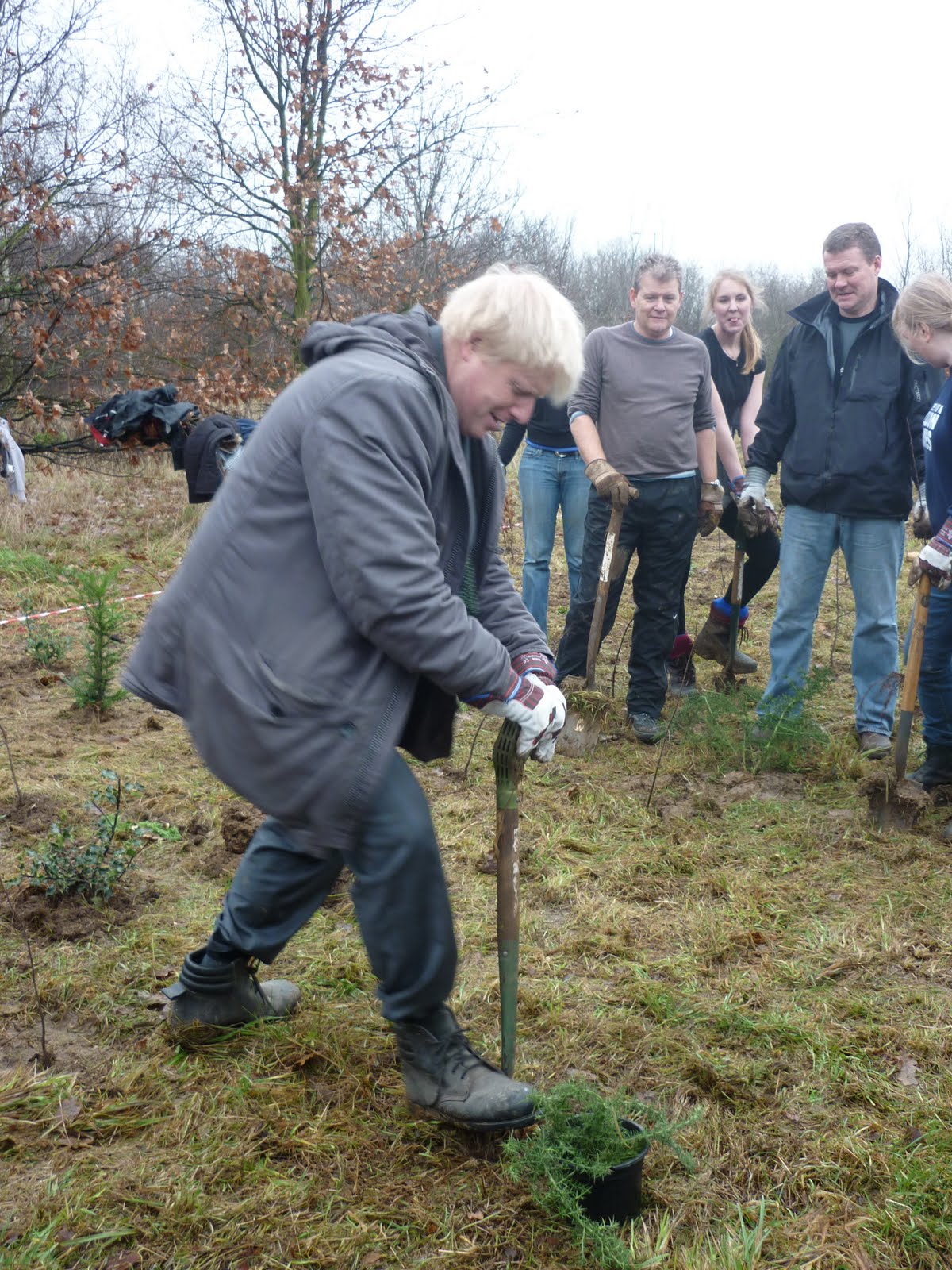
This morning I was with Boris, planting trees in the Roding Valley. We were welcomed by the Mayor of Redbridge, deputy leader Cllr Ian Bond (lib dem), and around a hundred volunteers as well as assorted journalists.


RE:LEAF London is the Mayor's new campaign which aims to encourage businesses and individuals to plant more trees across the capital, 'bringing the village to the city', as Boris puts it. This week 10,000 new trees are being planted in East London, many by volunteers from News International.


Experts from Trees For Cities made sure we were safely kitted out with gloves - wouldn't want to get a splinter or a nasty prick - before issuing spades and demonstrating how to plant a sapling. For apartment dwellers like myself this was a new experience but Boris went for it like an experienced pro.


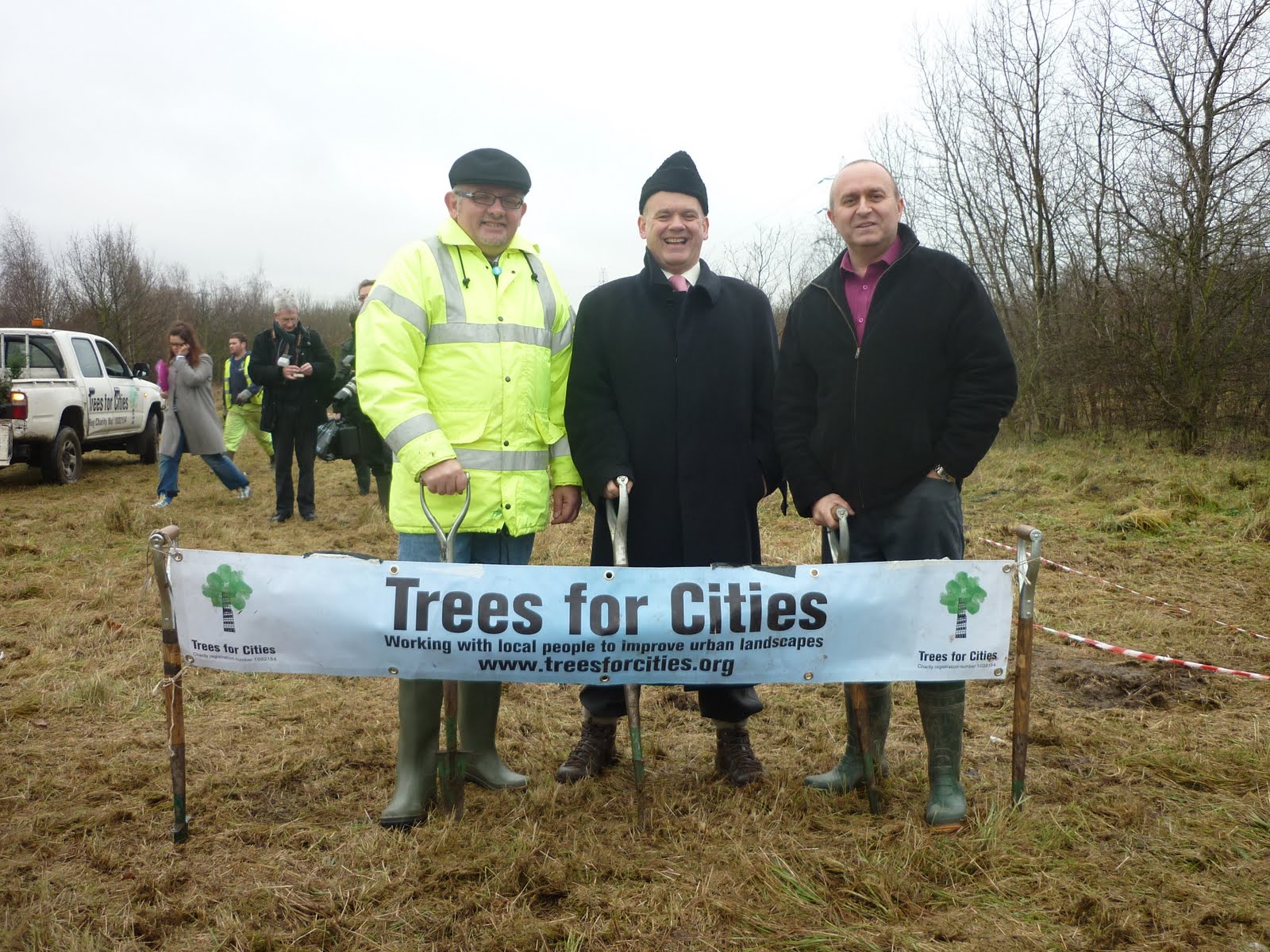
I paused for breath to be photographed with local Conservative councillors Paul Canal and Robin Turbefield, behind the Trees for Cities banner.


The new trees will greatly enhance this part of the borough and will help to soak up ground water in an area that suffered badly from flooding just a few years ago.

Tuesday, January 11, 2011

Budget Latest


This morning Boris gave evidence to the budget committee in a follow up from last weeks excellent session. Like Simon Milton he began by pointing out that for once, under the new government, London had received a better settlement than many other parts of the country. Against a background of cross the board reductions London had shouldered a 16% cut whereas the national average was 17%. The Mayor also expected further announcements in the coming days which would herald more money from government.


As usual, I pressed him to freeze the council tax precept not just this year, but in 2012/13 as well, leaving a 0% increase over his full term of office. Like Simon Milton, Boris refused to be drawn but he did point out that the freeze so far equated overall to a 6% cut, a welcome contrast to his predecessor who raised the precept by 153% during his term of office!


The Banks


As demonstrated on the last thread, whilst irrelevant to the detailed budget process, The Banks are very important to The Left, who try to use them as cover for their own fiscal irresponsibility. Len Duval suggested the Boris was wrong to defend bankers who could have been taxed more to fund London's budget. Leaving aside the very real possibility that London wouldn't even have seen a lot of the money, Boris emphasised the importance of the financial sector to the capital. Until an alternative source of employment and revenue is created, he is keen to protect what we do have.


Transport


Boris is particularly proud that tough lobbying has secured all the money needed for Crossrail, the Tube upgrades, and to protect concessionary fares including the vital 24hr Freedom Pass. The fare increases are unpopular but he reminded us that fares had risen by more than inflation under the previous Mayor too. He stated that the fares package would eliminate the black hole left in TfL's budget by Livingstone's decision to delay his fares package until after the election. The abolition of the zone 2-6 travelcard had been controversial but only 6,000 journeys - of a total 3.5 million - were made using these cards and in most cases Oyster pay as you go would provide a cost effective alternative.


I asked if upgrades to the main line stations in Havering and Redbridge were included in the Crossrail budget. Making the stations safer and more accessible is essential, but Boris pointed out that Network Rail were funding this part of the project. It is to be hoped that they won't be penny pinching here.


And John Biggs revealed that, despite living close to the centre of town, he hadn't ridden a bike in years. What a missed opportunity - we could all have been riding 'Biggs Bikes'...


Policing


The Mayor was pleased that crime continued to fall, despite the recession, and particularly on public transport. He was committed to driving down crime even further and to increasing police visibility on the beat. The recruitment freeze has led to a fall in police numbers but even so, Boris was confident that there would still be between 32 and 33 thousand fully warranted officers in the force in 2012 - more than the number he inherited from Ken. Again, some further announcements - he referred to them as 'sleek rabbits out of hats' - would be made during the budget process, and he intended also to protect PCSO numbers.


Asked about police overtime, the Mayor stated that the unpredictability of demonstrations and other disorder made it difficult to commit to a lower figure. Darren Johnson reported that only 7% of overtime was incurred policing public order situations, so there should be other ways it can be controlled. Boris promised to investigate further. I told the Mayor that abstraction of police officers from outer London to cover these events should be done as sparingly as possible.


Next Stages


The budget - and associated sleek rabbits - will now go on to be debated by the Assembly in February. A two thirds majority is needed to amend the proposals so changes will need to command cross party support. The next budget committee meeting takes place on 3rd March.

Wednesday, January 05, 2011

Budget Scrutiny


Today the budget committee took evidence from all the functional bodies and deputy mayor, Sir Simon Milton, in preparation for the impending budget settlement. This year the budget is set against the backdrop of essential cuts introduced by the government to recover the parlous financial situation left by the outgoing Labour government. For once, London fared better than many other parts of the country, having suffered the worst settlement for three successive years under the previous administration.


Overall Picture

Sir Simon confirmed that the council tax precept would be frozen once again, and spoke of his aspiration to achieve a freeze again in 2012/13.

For this year LFEPA had achieved particularly good savings enabling the transfer of £20 million from their budget to provide extra cash for the MPA where government grant had been less generous.

£23 million from government - council tax freeze specific grant - will be used to preserve some of the LDA's functions following abolition. Of this, £14 million will be supporting a new body - Promote London - which brings together the work of three existing bodies - Visit London, Think London and Study London. Together with economies of scale, Promote London will also seek private sponsorship to fund much of its work.

The London Skills and Employment Board is losing its powers to government and is unlikely to continue in such a vacuum.


Metropolitan Police Authority

The MPA is seeking to make further savings in what Deputy Mayor Kit Malthouse described as 'inanimate objects', whilst preserving its front line capacity.

By March 2011 they expect that 1,181 officers will have left the police service but these losses will be offset by deploying 550 officers currently in administrative roles - Operation Herald - and increased single patrolling. In London 800 officers are now on single patrol every day and there must be scope to continue to roll out this practice in all but the most challenging urban environments. Safer Neighbourhood Teams would be preserved although the supervision structure was being reviewed.

The disposal of properties would continue, particularly of old police stations which were no longer suitable for purpose. More services would be delivered from town centre and shopping parade locations, providing a more welcoming environment for victims and witnesses, whilst basing officers in the most populated areas.

Kit declared that he was more concerned by the cuts being implemented by local authorities. He stressed the importance of effective child protection and community safety services without which the police will struggle.

Deputy Commissioner Tim Godwin reassured the committee that the Metropolitan Police would be able to handle demonstrations and consequent public disorder, if necessary by abstracting officers from boroughs to police these events.


London Fire And Emergency Planning Authority

The committee congratulated Fire Commissioner Ron Dobson on his recognition in the New Year Honours List - he has been made a CBE. He assured us that whilst 121 administrative posts would be cut, there would be no cut in front line services.

The London Fire Brigade had received a good grant settlement, doing better than many rural brigades - Warwickshire was facing the closure of eight fire stations. Chairman Brian Coleman put this down to assiduous lobbying of government by himself and senior officers, and also to the previous experience of Fire Minister Bob Neill as chairman of the old LFCDA. It is good to have a minister who actually understands the needs of the capital.


Transport For London

Commissioner Peter Hendy was the only witness to turn up without other officers to support him. Peter is usually well briefed and doesn't need people whispering answers to him.

TfL's four year grant settlement fell short of previous expectations, leaving a funding gap of £2.17 billion, but Peter was confident that this could be bridged. Firstly there would be further efficiency savings, including 'Project Horizon', a wholesale restructuring of the organisation to strip out inefficiencies and over management - this was expected to achieve savings of up to 20% of the admin budget.

Peter also expected to over achieve on income from fares, following the latest increases. Numbers using the Tube particularly have boomed as the London economy recovers, to the point that once again there is no effective peak hour on London Underground. Peter was not being drawn on the level of this surplus, only saying that he expected it to reach several hundreds of millions.

TfL staff were awarded a 4.2% pay increase in 2010/11 as part of a package designed to cover two to three years. Peter was keen to honour the deal - notwithstanding the disagreement with ASLEF which caused the strike on Boxing Day - but after this period he could not rule out a pay freeze, already experienced by many elsewhere in the public sector.


Round Up

All in all this was an informative meeting which covered a good deal of ground. The committee reconvenes on Tuesday when we will be questioning the Mayor about his political priorities.


Saturday, January 01, 2011

New Year in London


This morning I decided to go into town to watch the New Year Parade. The journey proved to be more epic than usual, with the main line terminating at Seven Kings, so it was the 86 bus to Stratford, then the Jubilee Line to Westminster.


This year the parade started in Piccadilly, and progressed via Trafalgar Square and Whitehall to its conclusion in the shadow of Big Ben. There were the usual American marching bands and smiling cheerleaders - a welcome sign of the special relationship - and floating inflatable figures were back, by public demand. London boroughs provided floats and I managed to get a snap of the Havering entry, as well as catching the Mayor of Redbridge leaning from the top deck of a red bus. The biggest cheer was reserved for standard bearers from the Royal British Legion.


A wonderful way to start 2011, it got me thinking of the challenges that lie ahead. This is the year when David Cameron promises most of the 'heavy lifting' will be done, and no doubt the capital will see more protests and strikes in reaction to essential measures to bring the national debt back under control. Continuing work on London Underground will disrupt services, and we all hope for a more reliable network when the engineers move on. The referendum on AV will prove a political headache for both sides I suspect - I will be voting No.


But there will be high points too. In 2011 London will be leading the country out of recession, buoyed in the short term by the excitement of a Royal Wedding, and looking forward to the 2012 Olympics, as the huge site in the Lea Valley nears completion. More trees will be planted around town, the popular bike hire scheme will be extended and the final bendy bus will meander off to the dustbin of history. There is much to look forward too...


Saturday, December 04, 2010

Reselection Meeting

Last night forty people braved the snow and ice to attend my reselection meeting in Romford.

It began with a fifteen minute report back in which I covered my work in the last two years. Highlights included the opening of the new fire station at Gallows Corner - the first new fire station to be built in London for 20 years. I also talked about the success of Fairlop Waters in the Mayor's 'Trees for London' public vote, and the visit from William Torbitt primary school, which saw the children deliver 300 votes to City Hall.

On a policy note, I highlighted our continuing opposition to the proposals for an illegal immigrant amnesty, and our lobbying for legislation to control the turbulent industrial relations on the Tube. I talked about the changes to the London Plan, particularly the move away from large blocks of tiny flats, and the decision to remove arbitrary targets for travellers pitches in each borough.

Then we had thirty minutes of questions from an interested and engaged audience. Business people and charity groups wanted the costly low emission zone timetable delayed again. There were requests for Boris to do yet more to help cyclists, and local councillors demanded greater freedom from TfL dictat. We discussed the phasing out of bendy buses and there was much relief to hear that the infamous number 25 would be 'debendified' over the summer of 2011, and all would be gone by the election.

I left the room during the vote, which was a secret ballot. The numbers were not revealed but I'm told that I was reselected by an overwhelming majority. That means that almost all of the group have successfully completed the reselection process and soon we will be moving on to choosing and ranking the top up list. Only 18 months to the election...